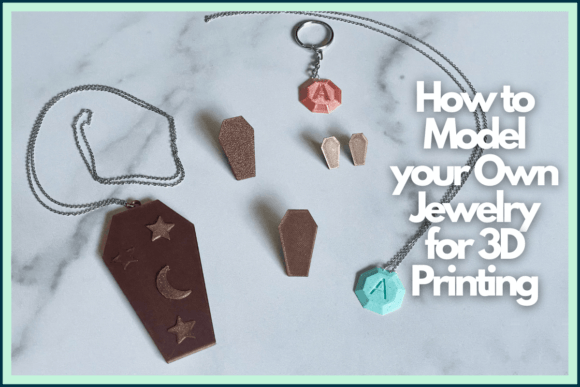
How to Model Your Own Jewelry for 3D Printing
The intersection of digital fabrication and personal adornment has shifted from a niche industrial capability to a mainstream creative frontier. For decades, jewelry design was the exclusive domain of master craftsmen who spent years mastering metalwork, casting, and stone setting. Today, that barrier is dissolving rapidly. The ability to model your own jewelry for 3D printing represents more than just a technical skill; it is a fundamental shift in how we conceptualize, create, and consume wearable art. This democratization of design allows anyone with an imagination to produce complex, geometrically impossible forms that were previously unmanufacturable or prohibitively expensive.
This transformation is not merely about speed; it is about accessibility and iteration. In the past, prototyping a single ring could take weeks due to the labor-intensive nature of wax carving and lost-wax casting. Now, with the right software and a desktop 3D printer, that same prototype can be realized in hours. This class, led by Ashley from Chipped Builds, serves as a practical entry point into this new workflow. By utilizing Tinkercad—a free, browser-based tool—the learning curve is significantly flattened, allowing beginners to focus on creativity rather than steep software acquisition costs.
The Evolution of Accessible Design Tools
Historically, professional 3D modeling required mastery of complex CAD (Computer-Aided Design) software like Rhino, Matrix, or ZBrush. These tools offer immense power but come with a steep learning curve that often discouraged hobbyists and small business owners. The emergence of intuitive, web-based platforms has changed this dynamic entirely. Tinkercad, originally designed for educational purposes, has proven its versatility in professional contexts, including jewelry making.
Why does this matter? Because the bottleneck in jewelry creation has always been the translation of idea to object. When you learn how to model your own jewelry for 3D printing using accessible tools, you remove that friction. You no longer need to communicate your vision through vague sketches or expensive consultants. You become the architect of your own designs. This direct line from mind to model fosters a deeper connection between the creator and the final product, a trend that resonates strongly with modern consumers who value authenticity and bespoke craftsmanship.
Mastering the Basics with Tinkercad
For those intimidated by the prospect of learning 3D modeling, the approach taken in this course is particularly empowering. Tinkercad operates on a "building blocks" philosophy. Instead of manipulating complex NURBS curves or polygonal meshes immediately, users start with basic geometric shapes—cylinders, cubes, and spheres—and combine them to form more complex structures. This additive approach mirrors physical sculpting, making it intuitive for artists and designers alike.
Ashley’s guidance in this class focuses on demystifying these basic steps. She walks participants through the interface, explaining how to manipulate scale, rotation, and position with precision. For jewelry, precision is critical. A clasp that is 0.5 millimeters too small will not function; a prong that is slightly misaligned may fail to hold a gemstone. The course emphasizes these practical nuances, ensuring that the digital models are not just visually appealing but structurally sound for manufacturing.
- Understanding Scale: One of the most common pitfalls for beginners is ignoring real-world dimensions. The class teaches how to set up the workspace to reflect actual measurements, ensuring that your digital necklace will fit a human neck when printed.
- Grouping and Ungrouping: Learning how to merge shapes is essential for creating hollow spaces, such as the inside of a ring band or the bail of a pendant. This technique allows for the creation of intricate lattices and interlocking components that define high-end 3D printed jewelry.
- Holes vs. Solids: A crucial concept in constructive solid geometry is distinguishing between solid objects and holes. Understanding how to use negative space to carve out details is fundamental to designing functional jewelry pieces.
From Digital Sketch to Physical Object
The curriculum covers the creation of two distinct necklaces and a set of earrings. These projects are selected not just for their aesthetic variety, but for the specific technical skills they impart. Necklaces often involve chain links, pendants, and clasps, requiring an understanding of connectivity and tension. Earrings, on the other hand, demand attention to weight distribution and post placement.
By completing these projects, students gain a portfolio-ready foundation. They learn to export files in the correct formats, typically STL or OBJ, which are universally accepted by 3D printing slicers and resin printers. This export process is often overlooked but is critical. A poorly exported file can result in print failures, wasted material, and frustrated creators. The class ensures that users understand the entire pipeline, from initial sketch to final export.
Moreover, this process opens up endless possibilities. Once you can model a simple earring, you can iterate on it endlessly. Change the texture, alter the geometry, add custom engravings. The marginal cost of experimentation is virtually zero compared to traditional methods where every change might require melting down wax or cutting new metal. This encourages a culture of rapid prototyping and continuous improvement.
Practical Implications for Creators and Entrepreneurs
For freelancers, entrepreneurs, and small business owners, the ability to model your own jewelry for 3D printing offers significant competitive advantages. It reduces reliance on external manufacturers for prototypes, speeding up time-to-market. It also allows for mass customization. In an era where consumers increasingly seek personalized products, being able to offer made-to-order jewelry at a reasonable price point is a powerful differentiator.
Consider the case of a boutique brand owner. Instead of holding inventory of fixed sizes or styles, they can maintain a digital library of designs. When a customer orders a piece, it is printed on-demand. This lean inventory model reduces waste and capital expenditure. Furthermore, the ability to modify designs quickly means that trends can be captured and produced almost instantly. If a particular geometric pattern becomes popular on social media, a designer with these skills can recreate and refine it within days, not months.
Educators and makerspaces also benefit greatly from this skill set. Teaching students how to design their own accessories integrates lessons in geometry, engineering, and digital literacy. It provides a tangible outcome that reinforces abstract concepts. Students see the direct result of their calculations and spatial reasoning, fostering engagement and confidence in STEM fields.
Bridging Technology and Artistry
While the tools are technological, the output is deeply artistic. There is a misconception that 3D printing leads to cold, impersonal designs. However, the opposite is often true. The freedom from traditional manufacturing constraints allows for organic, fluid forms that mimic natural structures. Lace-like patterns, fractal geometries, and biomimetic shapes are all achievable with digital modeling.
Ashley’s instruction highlights this balance. She does not just teach software commands; she teaches design thinking. How do you make a piece comfortable to wear? How do you ensure durability? How do you create visual interest without compromising structural integrity? These questions elevate the work from a simple tech demo to a genuine craft. The class empowers students to bring their unique artistic voice into the digital realm, ensuring that technology serves creativity rather than stifling it.
Getting Started: A Realistic Path Forward
Entering the world of 3D printed jewelry does not require a massive investment. With Tinkercad being free and many entry-level 3D printers available under $300, the barrier to entry is lower than ever. However, success requires patience and practice. Modeling is a skill that improves with repetition. Beginners should expect their first few attempts to have imperfections. This is part of the learning process.
The key is to start small. Begin with simple studs or charms before attempting complex multi-part assemblies. Focus on mastering the basics of alignment and scaling. As confidence grows, so does the complexity of the designs. The class provides a structured path through this progression, ensuring that learners build a solid foundation before tackling more ambitious projects.
Additionally, community engagement plays a vital role. Online forums and social media groups dedicated to 3D printing and jewelry making offer invaluable support. Sharing progress, asking for feedback, and learning from others’ mistakes accelerates growth. The knowledge gained in this class is a launchpad, not a destination. It equips you with the tools to join a global community of innovators who are redefining what jewelry can be.
Conclusion
The ability to model your own jewelry for 3D printing is more than a technical proficiency; it is a creative liberation. It breaks down the barriers between idea and reality, allowing for unprecedented levels of personal expression and business agility. Through the guided instruction of Ashley from Chipped Builds, using the accessible platform of Tinkercad, learners are equipped with the practical skills needed to navigate this exciting field. Whether you are a hobbyist looking for a new creative outlet, an entrepreneur seeking a competitive edge, or an educator aiming to inspire the next generation, this journey into digital jewelry design offers profound rewards. The future of adornment is digital, customizable, and limited only by your imagination.