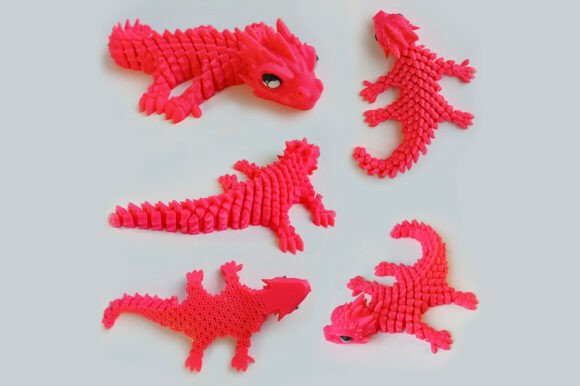
Articulated Dragon Print-in-Place 3D Model
There is a distinct satisfaction in watching a complex mechanical assembly emerge from a 3D printer without a single manual intervention. For hobbyists and professionals alike, the transition from static objects to dynamic, moving models represents a significant leap in creative potential. The Articulated Dragon Print-in-Place 3D Model exemplifies this shift, offering a fully flexible, print-in-place design that eliminates the frustration of post-processing while delivering a visually striking result. This model is not merely a decorative piece; it is an interactive object designed for smooth articulation, making it suitable for fidgeting, display, or gifting.
Unlike traditional models that require glue, pins, or complex assembly steps after printing, this dragon emerges from the build plate ready to move. Its hinged segments are engineered to glide seamlessly against one another, allowing the tail to curl, the wings to adjust, and the head to turn. This level of interactivity transforms a standard 3D print into a tactile experience, bridging the gap between digital fabrication and physical play. Whether you are looking to enhance your portfolio, create a unique gift, or simply enjoy the mechanics of motion, understanding how to leverage this specific model can improve your workflow and creative output.
Streamlining the Workflow with Print-in-Place Design
One of the most significant barriers to entry for many 3D printing enthusiasts is the time and skill required for post-processing. Removing supports, sanding layer lines, and assembling multiple parts can turn a quick print into a multi-day project. The Articulated Dragon – Fully Flexible Print-in-Place 3D Model addresses these pain points directly by integrating moving parts into the geometry itself. By optimizing the model for print-in-place manufacturing, users can bypass the need for assembly entirely.
This approach offers practical benefits beyond mere convenience. When a model requires no supports, the risk of surface damage during removal is eliminated, preserving the aesthetic quality of the print. Furthermore, reducing the number of components means there are fewer points of failure. A glued joint may weaken over time or become visible, but printed hinges maintain their integrity as long as the material holds. For educators and creators who demonstrate printing techniques, this model serves as an excellent case study in efficient design. It illustrates how thoughtful geometry can reduce waste and labor, a principle that applies equally to industrial prototyping and personal hobbies.
Optimizing Settings for Smooth Articulation
To achieve the full potential of the Articulated Dragon Print-in-Place 3D Model, precise printer settings are crucial. The success of any print-in-place mechanism depends heavily on the tolerances set during slicing. If the gaps between moving parts are too small, friction will prevent movement; if they are too large, the model may appear loose or unstable. Based on extensive testing with machines like the Bambu Lab A1 mini, specific parameters yield the best results.
- Nozzle and Material: Using a 0.4 mm nozzle with PLA filament provides a reliable balance of detail and strength. PLA is preferred for its stiffness and ease of use, though PETG can be considered for increased durability at the cost of slightly tighter tolerances.
- Layer Height: A layer height of 0.16 mm is optimal. This setting provides enough resolution to define the intricate hinge mechanisms without extending print times unnecessarily.
- Temperatures: Setting the nozzle temperature to 220 °C and the bed temperature to 65 °C on a textured plate ensures strong adhesion and consistent extrusion. Proper thermal management prevents warping, which could misalign the articulated segments.
- Speed and Z-hop: Printing at speeds up to 200 mm/s with a Z-hop of 0.4 mm helps maintain momentum and reduces stringing, keeping the moving parts clean. However, if the dragon’s segments bind, reducing speed slightly around the hinge areas can improve accuracy.
- Infill and Walls: An infill density of 15% using a grid pattern offers sufficient structural integrity without adding unnecessary weight. Two wall loops provide the necessary shell strength to withstand repeated handling.
It is important to note that these settings serve as a baseline. Users with different printers or environmental conditions may need to adjust tolerance values. Some slicers allow for "extra perimeters" or specific gap adjustments for moving parts. Experimentation is key, and starting with a test print of just the hinge section can save material and time before committing to the full model.
Creative Applications and Audience Fit
The versatility of the Articulated Dragon Print-in-Place 3D Model makes it relevant to a wide range of users. For fantasy enthusiasts and collectors, the model offers a tangible connection to popular lore, bringing mythical creatures to life on a desk or shelf. The inclusion of dragon eyes with an optional glint effect adds a touch of realism that enhances its display value. However, its appeal extends far beyond niche fandoms.
For marketers and content creators, this model serves as a powerful visual aid. In presentations about innovation, creativity, or manufacturing technology, having a physical object that moves captures attention more effectively than slides alone. It demonstrates the capabilities of modern additive manufacturing in a way that is immediately understandable. Similarly, educators can use the dragon to teach principles of kinematics, engineering design, and material science. Students can observe how linkages work in real-time, making abstract concepts concrete.
Freelancers and entrepreneurs might find value in the model as a unique promotional item or a high-quality giveaway. Unlike mass-produced plastic toys, a 3D-printed articulated dragon feels bespoke and thoughtful. It signals an appreciation for design and technology, which can strengthen brand perception among tech-savvy clients. Additionally, for individuals seeking stress relief, the smooth motion of the dragon’s segments provides a satisfying tactile experience, similar to other fidget tools but with a more distinctive aesthetic.
Considerations for Long-Term Use
While the Articulated Dragon – Fully Flexible Print-in-Place 3D Model is robust, users should be aware of certain limitations inherent to 3D printing materials. PLA, while easy to print, has a relatively low heat resistance. Leaving the model in a hot car or near direct sunlight for extended periods may cause deformation, particularly in the thin hinge sections. For environments with higher temperatures, switching to ASA or PETG is advisable, though this may require adjusting print settings to account for different shrinkage rates.
Another consideration is wear over time. Repeated flexing of the printed hinges can eventually lead to fatigue, especially if the model is handled roughly. While PLA is durable, it is not indestructible. Users who plan to handle the model frequently should do so gently, treating it as a precision instrument rather than a toy. Regular cleaning to remove dust from the joints can also help maintain smooth operation.
Compatibility is another factor to keep in mind. The recommended settings are optimized for printers with a 0.4 mm nozzle, such as the Bambu Lab A1, P1P, X1 series, and H2D. Users with larger nozzles may need to scale the model or adjust slice settings to ensure the moving parts function correctly. Always verify that your printer’s build volume can accommodate the dragon’s dimensions, as larger articulated models can span significant space when fully extended.
Conclusion
The Articulated Dragon Print-in-Place 3D Model represents a convergence of design efficiency and interactive artistry. By eliminating assembly and support requirements, it allows creators to focus on what matters most: the final result. Whether used for education, decoration, or professional demonstration, this model delivers a high-impact experience with minimal effort. As 3D printing continues to evolve, models like this highlight the medium’s potential to produce not just static shapes, but living, moving objects that engage users on a deeper level. For anyone looking to expand their printing repertoire or add a dynamic element to their workspace, this dragon offers a compelling solution.